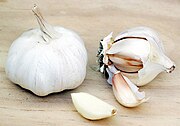
Allium sativum L., commonly known as garlic, is a species in the onion family Alliaceae. Its close relatives include the onion, shallot, leek, and chive. Garlic has been used throughout recorded history for both culinary and medicinal purposes. It has a characteristic pungent, spicy flavor that mellows and sweetens considerably with cooking.[1] A bulb of garlic, the most commonly used part of the plant, is divided into numerous fleshy sections called cloves. The cloves are used as seed, for consumption (raw or cooked), and for medicinal purposes. The leaves, stems (scape), and flowers (bulbils) on the head (spathe) are also edible and are most often consumed while immature and still tender. The papery, protective layers of "skin" over various parts of the plant and the roots attached to the bulb are the only parts not considered palatable.
Origin and distributionGarlic output in 2005.The ancestry of cultivated garlic, according to Zohary and Hopf, is not definitely established: "A difficulty in the identification of its wild progenitor is the sterility of the cultivars."[2]
Allium sativum grows in the wild in areas where it has become naturalised; it probably descended from the species Allium longicuspis, which grows wild in southwestern Asia.[3] The "wild garlic," "crow garlic," and "field garlic" of Britain are the species Allium ursinum, Allium vineale, and Allium oleraceum, respectively. In North America, Allium vineale (known as "wild garlic" or "crow garlic") and Allium canadense, known as "meadow garlic" or "wild garlic" and "wild onion," are common weeds in fields.[4] One of the best-known "garlics," the so-called elephant garlic, is actually a wild leek (Allium ampeloprasum).
Side EffectsAfter eating a large quantity of garlic, a person will usually have halitosis. Their sweat and excreted oils will also smell like garlic. If an extremely large amount of garlic has been consumed, the person's mucus, vaginal discharge, dandruff, and even earwax will also smell like garlic.[citation needed] Washing the body with soap will not take away the scent, although perfumes will mask it. The smell usually fades over the course of several days.[citation needed]
CultivationGarlic growing in a container.Garlic is easy to grow and can be grown year-round in mild climates. In cold climates, cloves can be planted in the ground about six weeks before the soil freezes and harvested in late spring. Garlic plants are not attacked by pests. They can suffer from pink root, a disease that stunts the roots and turns them pink or red. Garlic plants can be grown close together, leaving enough room for the bulbs to mature, and are easily grown in containers of sufficient depth.
There are different types or subspecies of garlic, most notably hardneck garlic and softneck garlic. It is important to get the right kind of garlic for your latitude, as garlic can be day-length sensitive. Hardneck garlic is generally grown in cooler climates; softneck garlic is generally grown closer to the equator.[citation needed]
Production trendsGarlic is grown globally, but China is by far the largest producer of garlic, with approximately 10.5 billion kilograms (23 billion pounds) annually, accounting for over 77% of world output. India (4.1%) and South Korea (2%) follow, with Russia (1.6%) in fourth place and the United States (where garlic is grown primarily as a cash crop in every state except for Alaska) in fifth place (1.4%).[2] This leaves 16% of global garlic production in countries that produce less than 2% of global output. Much of the garlic production in the United States is centered on Gilroy, California, which calls itself the "garlic capital of the world." The town holds a garlic festival annually, which raises money for charity.[5]
Uses
Culinary usesGarlic being crushed using a garlic press. Garlic bulbs and individual cloves, one peeled. Garlic scapes are often harvested early so that the bulbs will grow bigger.Garlic is widely used around the world for its pungent flavor as a seasoning or condiment. It is a fundamental component in many or most dishes of various regions, including eastern Asia, south Asia, Southeast Asia, the Middle East, northern Africa, southern Europe, and parts of South and Central America. The flavour varies in intensity and aroma with the different cooking methods. It is often paired with onion, tomato, or ginger. The parchmentlike skin is much like the skin of an onion and is typically removed before using in raw or cooked form. An alternative is to cut the top off the bulb, coat the cloves by dribbling olive oil (or other oil-based seasoning) over them, and roast them in the oven. The garlic softens and can be extracted from the cloves by squeezing the (root) end of the bulb, or individually by squeezing one end of the clove.
Oils are often flavored with garlic cloves. Commercially prepared oils are widely available, but when preparing garlic-infused oil at home, there is a risk of botulism if the product is not stored properly. To reduce this risk, the oil should be refrigerated and used within one week. Manufacturers add acids and/or other chemicals to eliminate the risk of botulism in their products.[6]
In some cuisine, the young bulbs are pickled for 3–6 weeks in a mixture of sugar, salt, and spices. In eastern Europe, the shoots are pickled and eaten as an appetizer.
Immature scapes are tender and edible. They are also known as "garlic spears," "stems," or "tops." Scapes generally have a milder taste than cloves. They are often used in stir frying or prepared like asparagus. Garlic leaves are a popular vegetable in many parts of Asia. The leaves are cut, cleaned, and then stir-fried with eggs, meat, or vegetables.
Mixing garlic with eggs and olive oil produces aioli. Garlic, oil, and a chunky base produce skordalia. Blending garlic, almond, oil, and soaked bread produces ajoblanco.
About 1/4 teaspoon of dried powdered garlic is equivalent to one fresh clove.
Storage
Domestically, garlic is stored warm (above 18°C [64°F]) and dry to keep it dormant (so that it does not sprout). It is traditionally hung; softneck varieties are often braided in strands, called "plaits" or grappes. Garlic is often kept in oil to produce flavoured oil; however, the practice requires measures to be taken to prevent the garlic from spoiling. Untreated garlic kept in oil at room temperature can support the growth of deadly Clostridium botulinum. Peeled cloves may be stored in wine or vinegar in the refrigerator.[7]
Commercially, garlic is stored at −3°C, also dry.[8][9]
Historical useGarlic has been used as both food and medicine in many cultures for thousands of years, dating at least as far back as the time that the Giza pyramids were built. It formed part of the diet of the Israelites in Egypt (Numbers 11:5) and of the labourers employed by Khufu in constructing the pyramid. Garlic is still grown in Egypt, but the Syrian variety is the kind most esteemed now (see Rawlinson's Herodotus, 2.125).
It was consumed by ancient Greek and Roman soldiers, sailors, and rural classes (Virgil, Ecologues ii. 11), and, according to Pliny the Elder (Natural History xix. 32), by the African peasantry. Galen eulogizes it as the "rustic's theriac" (cure-all) (see F. Adams' Paulus Aegineta, p. 99), and Alexander Neckam, a writer of the 12th century (see Wright's edition of his works, p. 473, 1863), recommends it as a palliative for the heat of the sun in field labor.
In the account of Korea's establishment as a nation, gods were said to have given mortal women with bear and tiger temperaments an immortal's black garlic before mating with them. This is a genetically unique six-clove garlic that was to have given the women supernatural powers and immortality. This garlic is still cultivated in a few mountain areas today.
In his Natural History, Pliny gives an exceedingly long list of scenarios in which it was considered beneficial (N.H. xx. 23). Dr. T. Sydenham valued it as an application in confluent smallpox, and, says Cullen (Mat. Med. ii. p. 174, 1789), found some dropsies cured by it alone. Early in the 20th century, it was sometimes used in the treatment of pulmonary tuberculosis or phthisis.
Harvesting garlic, from Tacuinum sanitatis, 15th century (Bibliothèque nationale).Garlic was rare in traditional English cuisine (though it is said to have been grown in England before 1548) and has been a much more common ingredient in Mediterranean Europe. Garlic was placed by the ancient Greeks on the piles of stones at crossroads, as a supper for Hecate (Theophrastus, Characters, The Superstitious Man); and according to Pliny, garlic and onions were invoked as deities by the Egyptians at the taking of oaths. (Pliny also states that garlic demagnetizes lodestones, which is not factual.)[10] The inhabitants of Pelusium, in lower Egypt (who worshiped the onion), are said to have had an aversion to both onions and garlic as food.
To prevent the plant from running to leaf, Pliny (N.H. xix. 34) advised bending the stalk downward and covering with earth; seeding, he observes, may be prevented by twisting the stalk (by "seeding," he most likely meant the development of small, less potent bulbs).
Medicinal use and health benefits
Garlic, raw
Nutritional value per 100 g (3.5 oz)
Energy 150 kcal 620 kJ
Carbohydrates 33.06 g
- Sugars 1.00g
- Dietary fiber 2.1 g
Fat 0.5 g
Protein 6.39 g
- β-carotene 5 μg 0%
Thiamin (Vit. B1) 0.2 mg 15%
Riboflavin (Vit. B2) 0.11 mg 7%
Niacin (Vit. B3) 0.7 mg 5%
Pantothenic acid (B5) 0.596 mg 12%
Vitamin B6 1.235 mg 95%
Folate (Vit. B9) 3 μg 1%
Vitamin C 31.2 mg 52%
Calcium 181 mg 18%
Iron 1.7 mg 14%
Magnesium 25 mg 7%
Phosphorus 153 mg 22%
Potassium 401 mg 9%
Sodium 17 mg 1%
Zinc 1.16 mg 12%
Manganese 1.672 mg
Selenium 14.2 mcg
Percentages are relative to USrecommendations for adults.
Source: USDA Nutrient database
Garlic is claimed to help prevent heart disease (including atherosclerosis, high cholesterol, and high blood pressure) and cancer.[11] Animal studies, and some early investigational studies in humans, have suggested possible cardiovascular benefits of garlic. A Czech study found that garlic supplementation reduced accumulation of cholesterol on the vascular walls of animals.[12] Another study had similar results, with garlic supplementation significantly reducing aortic plaque deposits of cholesterol-fed rabbits.[13] Another study showed that supplementation with garlic extract inhibited vascular calcification in human patients with high blood cholesterol.[14] The known vasodilative effect of garlic is possibly caused by catabolism of garlic-derived polysulfides to hydrogen sulfide in red blood cells, a reaction that is dependent on reduced thiols in or on the RBC membrane. Hydrogen sulfide is an endogenous cardioprotective vascular cell-signaling molecule.[15]
However, a randomized clinical trial funded by the National Institutes of Health (NIH) in the United States and published in the Archives of Internal Medicine in 2007 found that the consumption of garlic in any form did not reduce blood cholesterol levels in patients with moderately high baseline cholesterol levels.[16][17]
“ Despite decades of research suggesting that garlic can improve cholesterol profiles, a new NIH-funded trial found absolutely no effects of raw garlic or garlic supplements on LDL, HDL, or triglycerides… The findings underscore the hazards of meta-analyses made up of small, flawed studies and the value of rigorously studying popular herbal remedies.
In 2007, the BBC reported that Allium sativum may have beneficial properties, such as preventing and fighting the common cold.[19] This assertion has the backing of long tradition in herbal medicine, which has used garlic for hoarseness and coughs.[20] The Cherokee also used it as an expectorant for coughs and croup.[21]
Allium sativum has been found to reduce platelet aggregation[22][23][24][25] and hyperlipidemia.[26][25][27]
Garlic is also alleged to help regulate blood sugar levels. Regular and prolonged use of therapeutic amounts of aged garlic extracts lower blood homocysteine levels and has shown to prevent some complications of diabetes mellitus.[28][29] People taking insulin should not consume medicinal amounts of garlic without consulting a physician.
In 1858, Louis Pasteur observed garlic's antibacterial activity, and it was used as an antiseptic to prevent gangrene during World War I and World War II.[30] More recently, it has been found from a clinical trial that a mouthwash containing 2.5% fresh garlic shows good antimicrobial activity, although the majority of the participants reported an unpleasant taste and halitosis.[31]
In modern naturopathy, garlic is used as a treatment for intestinal worms and other intestinal parasites, both orally and as an anal suppository. Garlic cloves are used as a remedy for infections (especially chest problems), digestive disorders, and fungal infections such as thrush.[3][4]
Garlic has been used reasonably successfully in AIDS patients to treat cryptosporidium in an uncontrolled study in China.[32] It has also been used by at least one AIDS patient to treat toxoplasmosis, another protozoal disease.[33]
Garlic supplementation in rats, along with a high protein diet, has been shown to boost testosterone levels.[34]
PropertiesWhen crushed, Allium sativum yields allicin, a powerful antibiotic and antifungal compound (phytoncide). However, due to poor bioavailability, it is of limited use for oral consumption. It also contains alliin, ajoene, enzymes, vitamin B, minerals, and flavonoids.
The composition of the bulbs is approximately 84.09% water, 13.38% organic matter, and 1.53% inorganic matter, while the leaves are 87.14% water, 11.27% organic matter, and 1.59% inorganic matter.[citation needed]
The phytochemicals responsible for the sharp flavor of garlic are produced when the plant's cells are damaged. When a cell is broken by chopping, chewing, or crushing, enzymes stored in cell vacuoles trigger the breakdown of several sulfur-containing compounds stored in the cell fluids. The resultant compounds are responsible for the sharp or hot taste and strong smell of garlic. Some of the compounds are unstable and continue to evolve over time. Among the members of the onion family, garlic has by far the highest concentrations of initial reaction products, making garlic much more potent than onions, shallots, or leeks.[35] Although people have come to enjoy the taste of garlic, these compounds are believed to have evolved as a defensive mechanism, deterring animals like birds, insects, and worms from eating the plant. Humans, however, usually enjoy these sensations for some reason.[36]
A large number of sulfur compounds contribute to the smell and taste of garlic. Diallyl disulfide is believed to be an important odour component. Allicin has been found to be the compound most responsible for the "hot" sensation of raw garlic. This chemical opens thermoTRP (transient receptor potential) channels that are responsible for the burning sense of heat in foods. The process of cooking garlic removes allicin, thus mellowing its spiciness.[37]
When eaten in quantity, garlic may be strongly evident in the diner's sweat and breath the following day. This is because garlic's strong-smelling sulfur compounds are metabolized, forming allyl methyl sulfide. Allyl methyl sulfide (AMS) cannot be digested and is passed into the blood. It is carried to the lungs and the skin, where it is excreted. Since digestion takes several hours, and release of AMS several hours more, the effect of eating garlic may be present for a long time.
This well-known phenomenon of "garlic breath" is alleged to be alleviated by eating fresh parsley. The herb is, therefore, included in many garlic recipes, such as Pistou, Persillade, and the garlic butter spread used in garlic bread. However, since the odour results mainly from digestive processes placing compounds such as AMS in the blood, and AMS is then released through the lungs over the course of many hours, eating parsley provides only a temporary masking. One way of accelerating the release of AMS from the body is the use of a sauna. Due to its strong odor, garlic is sometimes called the "stinking rose."
Because of the AMS in the bloodstream, it is believed by some to act as a mosquito repellent. However, there is no evidence to suggest that garlic is actually effective for this purpose.[38]
Spiritual and religious perceptionsGarlic has been regarded as a force for both good and evil. A Christian myth considers that after Satan left the Garden of Eden, garlic arose in his left footprint and onion in the right.[39] In Europe, many cultures have used garlic for protection or white magic, perhaps owing to its reputation as a potent preventative medicine.[40] Central European folk beliefs considered garlic a powerful ward against demons, werewolves, and vampires.[40] To ward off vampires, garlic could be worn, hung in windows, or rubbed on chimneys and keyholes.[41]
In Taoism mythology, six-clove black garlic is used as part of the process of modifying a Taoist's genetics. It supposedly endows the users immortality by intensifying their vital energy or "chi."[citation needed]
The association of garlic to evil spirits may be based on the antibacterial, antiparasitic value of garlic, which could prevent infections that lead to delusions and other related mental illness symptoms.[42][43]
In both Hinduism and Jainism, garlic is considered to stimulate and warm the body and to increase one's desires. Hindus generally avoid using garlic and the related onion in the preparation of foods for religious festivities and events. Followers of the Jain religion avoid eating garlic and onion on a daily basis.
In connection with the odor associated with garlic, Islam views eating garlic and subsequently going to the mosque as inappropriate. "Whoever has eaten (garlic) should not approach our mosque," indicated Muhammad.[44]
CautionsKnown adverse effects of garlic include halitosis (nonbacterial bad breath), indigestion, nausea, emesis, and diarrhea.[45]
Garlic may interact with warfarin, antiplatelets, saquinavir, antihypertensives, calcium channel blockers, and hypoglycemic drugs, as well as other medications. Consult a health professional before taking a garlic supplement[45] or consuming excessive amounts of garlic.
Garlic can thin the blood, similar to the effect of aspirin.[46]
Two outbreaks of botulism have been caused by consuming commercially produced garlic-in-oil preparations that were not properly preserved. It is especially important for home preparation to use safe and tested food preservation methods to retard bacterial growth, such as including sufficient salt or acidity and keeping the mixture refrigerated. It is recommended to not keep home preparations for more than a week.[47][48]
While culinary quantities are considered safe for consumption, very high quantities of garlic and garlic supplements have been linked with an increased risk of bleeding, particularly during pregnancy and after surgery and childbirth.[49][45] Some breastfeeding mothers have found their babies slow to feed and have noted a garlic odour coming from their baby when they have consumed garlic.[50][45] The safety of garlic supplements had not been determined for children.[50]
The side effects of long-term garlic supplementation, if any exist, are largely unknown, and no FDA-approved study has been performed. However, garlic has been consumed for several thousand years without any adverse long-term effects, suggesting that modest quantities of garlic pose, at worst, minimal risks to normal individuals. Possible side effects include gastrointestinal discomfort, sweating, dizziness, allergic reactions, bleeding, and menstrual irregularities.[49]
Some degree of liver toxicity has been demonstrated in rats, particularly in extremely large quantities exceeding those that a rat would consume under normal situations.[51]
There have been several reports of serious burns resulting from garlic being applied topically for various purposes, including naturopathic uses and acne treatment, so care must be taken to test a small area of skin using a very low concentration of garlic.[52] On the basis of numerous reports of such burns, including burns to children, topical use of raw garlic, as well as insertion of raw garlic into body cavities, is discouraged. In particular, topical application of raw garlic to young children is not advisable.[53]
Garlic and onions might be toxic to cats or dogs.[54]
From
Wikipedia